Overcoming The Battle in Your Mind With Christ

Overcoming Other Challenges With Our Circumstances

As optimistic as we may be, we are sure to encounter challenges that will try our ability to practice active patience during troublesome situations.

The first challenge to overcome is to accept that, despite the goals we may have set or the outcome we hope to attain from a situation, we have no guarantee that God will satisfy our desires.

We might not get that dream job or be cured of our illness. While God can and has performed miracles, He isn’t a genie up in the sky booming “YOUR WISH IS MY COMMAND!” to everything we may want.

Read and Learn More How Leaders Can Cultivate Patience in an Impatient World ?

God is sovereign and because of that knows best of all how to achieve His plans. The truth is that most of the circumstances that require our patience do not include specific promises from God.

God has promised to meet our needs, but that isn’t a guarantee that all of our wishes will come true.

Psalm 37-4

It’s easy to interpret the above verse to mean we can get whatever we want if we just believe enough, but that thinking has a few flaws.

First, it doesn’t take into consideration the first part of the verse, that we should take delight in the Lord. In other words, trust that His plan is primary, not our desires.

Second, we may not even know what the desires of our hearts are. We are bombarded daily with worldly influences and the devil’s prodding.

While we may believe that one thing is what we want in life, we might be missing out on something even better. Is the first the desire of our heart just because it is known? Who better, God or us, to know what will make us truly happy?

I think about a friend of mine who was feeling discouraged in life. His work wasn’t satisfying, and that frustration was starting to spill over into his family and personal life as well.

He began to self-medicate with too much TV and rich food. Over time, he became more and more out of shape and started to put on the pounds. That added stress did little to improve his attitude toward life.

Then, one day he was hit with a case of gout. You may be aware that gout is an inflammatory condition that affects the foot. It is very painful and can spread all the way up the leg, causing extreme discomfort, to the point where concentration on anything else is nearly impossible.

My friend saw his doctor, who frankly told him it was the wrong food and lifestyle choices that were giving him his pain, and challenged him to clean up his eating habits and get healthy again—the alternative: a future of painful gout attacks.

He agreed to give it a try, but like breaking free of any stronghold, it wasn’t easy. He went through the entire grief process. Denial: “It isn’t what I eat, maybe I have a broken ankle or a tumor…” Anger: “Why did this happen to me?”

Bargaining: “Okay, I’ll be good for a month, then I can go back to my old ways…” Depression: “I’m never going to be able to eat anything but salad for the rest of my life.” And finally, Acceptance: “Whole grain is not so bad, and it fills me up for a long time!”

In just three short weeks, my friend is reporting not only much less pain from gout but also a fresh and more creative outlook on his work and with his family and friends. His life is back on the right track, and some of his stalled dreams have revived.

My point with this story isn’t to start eating more healthily (although this is not a bad idea), but to ask you to understand that sin and Satan’s attempts to derail us keep us chained to the mundane when God has greater things in store for us.

So even if we don’t get the desires of our hearts, we shouldn’t lose patience or get angry with God. He knows what the real desires of our hearts are, and will settle for nothing less. We shouldn’t either.

The Role of Grace in Salvation

The Role of Grace in Salvation

Certainly, the most well-known passage that speaks to the subject of this chapter is Ephesians 2:8-9.

Arminians and Calvinists alike would endorse what the Apostle Paul says with a hearty “Amen.”

Ephesians 2-8-9

This does not mean that members of the two camps are in agreement when it comes to the role of grace in salvation. As we will soon see, they are not.

Arminians and those of the Reformed persuasion would also unequivocally accept the familiar words that Jesus spoke to Nicodemus: “I tell you the truth, no one can see the kingdom of God unless he is born again” (John 3:3), as well as the clarifying remarks we find two verses later, “I tell you the truth, no one can enter the kingdom of God unless he is born of water and the Spirit” (v. 5).

Read and Learn More Prayers of Perseverance

John 3-3

The words of Paul to Titus are also accepted without reservation by both camps: “But when the kindness and love of God our Savior appeared, he saved us, not because of righteous things we had done, but because of his mercy.

He saved us through the washing of rebirth and renewal by the Holy Spirit, whom He poured out on us generously through Jesus Christ our Savior” (Titus 3:4-5).

Titus 3-4-5

“Being born again,” “rebirth,” or, to give its theological name, “regeneration” (which means “to generate again”), is an idea that all orthodox Christians accept, for it is clearly and repeatedly taught in Scripture.

But this does not mean that Arminians and Reformed Christians are in agreement about regeneration. In particular, they have different views when it comes to whether or not regeneration must take place in the heart of the individual prior to that person’s response to the Gospel.

Reformed thinkers claim that because apart from the regenerating work of the Holy Spirit we are all dead in sin, we have no ability to respond in faith unless we are first made alive by the Spirit.

Arminians argue that we have a natural ability to respond to the call of the Gospel, and only when we take that first step does the Holy Spirit begin the work of regeneration.

When discussing the primacy of God’s grace in the salvation of the individual, Reformed thinkers sometimes speak of “irresistible grace.” This term is misleading. If by “grace” we mean simply the proclamation of salvation by grace, then grace is certainly resistible.

The unbeliever continually resists the Good News that we are saved from our sins by the grace of God and the shed blood of Christ. Even those who will one day accept the Gospel and come to faith in Christ may resist for a time (perhaps even a very long time).

A better term is “efficacious grace.” By this, it means that God is the One who “affects” (or “brings about”) our salvation. It is not a cooperative effort between human beings and God.

Rather, the process whereby we are saved is a work of God from first to last. That view that God alone brings about our salvation (that is, makes it a reality) is sometimes called “monergism.”

(“Monergism” comes from the Greek words “Monos/’ which means “one/’ and “ergon/’ which means “work.” Hence, the work of salvation is “monergistic,” in that it is God’s work from the beginning to the end.)

Arminians generally deny efficacious grace. Although they may (and most of them do) argue that God’s work is primary, nevertheless in some sense they regard the work of salvation as a cooperative work.

Hence, God’s work alone does not bring about our salvation. Their view is known as “synergism.”

(This term derives from the Greek prefix “sun,” which means “with” or “together with” and “ergon.” Because the work of salvation is a cooperative effort between man and God, it is “synergistic.”)

Because Arminians and Reformed thinkers differ on whether salvation is monergistic or synergistic they differ on what is sometimes called “the order of salvation,” a term that refers to the steps in the process whereby our salvation is initiated, progresses, and is ultimately completed.

These steps include the external call, regeneration, the internal call, conversion, justification, sanctification, and glorification.

(Sometimes other steps are added to this list. For example, the “mystical union” between Christ and believers is frequently placed on this list, as is “repentance,” which some distinguish from conversion while others regard as part of the process of conversion.)

The main difference between the Arminian and the Reformed camp, when it comes to the order of salvation, is the placement of the step of regeneration.

Reformed thinkers generally place it immediately after the external call. Arminians see regeneration as following the internal call and possibly even conversion.

So that we have a better understanding of the issue, let’s briefly describe the first few steps. (Since Arminians and Calvinists generally agreed on the order of salvation after conversion, we won’t discuss these in this chapter.)

The external call

Romans 10-14-15

If sinners are to come to repentance and faith in Christ, they must hear the Gospel. And if they are to hear the Gospel, someone must present it to them.

In what is known as the Great Commission, Jesus, after His resurrection, commands His disciples as follows: “All authority in heaven and on earth has been given to me.

Therefore go and make disciples of all nations, baptizing them in the name of the Father and of the Son and of the Holy Spirit, and teaching them to obey everything I have commanded you” (Matthew 28:18-19).

Matthew 28-18-19

The presentation of the Gospel is part of this commission. Making disciples by teaching them to obey our Lord’s commands requires first of all that they hear the Good News of salvation by grace through faith in the atoning work of Jesus Christ.

This presentation, whereby sinners are called to repentance, is sometimes referred to as the external call.

The external call involves what is sometimes called the “free offer of the Gospel.” What this means above all is that the offer is genuine. Immediately before the above-quoted passage from Romans 10, Paul writes, “As the Scripture says, ‘Anyone who trusts in him will never be put to shame’ [Isaiah 28:16].

For there is no difference between Jew and Gentile- [Joel 2:32]” (v. 11-13).

Anyone who trusts in him will never be put to shame

When the good news is proclaimed that Jesus has died to save sinners and to redeem them from their sin and misery, it must be accompanied by the assurance that all those who by grace place their trust in His atoning work will be saved.

Regeneration

As already indicated, Reformed thinkers argue that regeneration comes next in the order of salvation. Why is this?

Above all else, it is because we are conceived and born in sin (Psalm 51:5) and are therefore dead in our transgressions and sins (Ephesians 2:1). Because we are dead, we have absolutely no ability to respond to the Gospel on our own.

Psalm 51-5 And Ephesians 2-1

If we were left to our own devices, the preaching of the Gospel would always fall on deaf ears. The external call would always be of no effect.

If we are to answer the call of the Gospel, God must step in. He must make us spiritually alive. He must regenerate us

Regeneration is described in the Bible in various ways. The most common way is through the use of the Greek verbs “gennao” and “anagennao.” The former of these means to be born, the latter to be born again.

As we have already seen, in His discussion with Nicodemus, Jesus tells him, “No one can see the kingdom of God unless he is born again”.

When Nicodemus shows confusion regarding what it might be to be born a second time, Jesus says, “I tell you the truth, no one can enter the kingdom of God unless he is born of water and the Spirit” (v. 5).

The Apostle Peter speaks of believers as being born again (1 Peter 1:23), and John, in his first letter, frequently refers to those who have been saved as being “born of God” (1 John 2:29; 3:9; 4:7; 5:1,4,18).

Apostle Peter speaks of believers as being born again

The Apostle Paul uses the verb “ktizo” (to create) and “ktisis” (creation) to describe this work of God. We are “created in Christ Jesus” (Ephesians 2:10) and are “new creations” in Him (2 Corinthians 5:17).

The Apostle Paul uses the verb ktizo and ktisis to describe this work of God

It is clear from what Paul says that it is God Who has brought about this new creation in us. He has done so through the regenerating work of the Holy Spirit.

That the work of regeneration is a work of God is also evident in what Paul says in Ephesians 2:4-5, where he uses a form of the verb “suzoopoieo” (“to make alive together with”) to describe this divine work.

Similarly, in Colossians 2:13

When you were dead in your sins and in the uncircumcision of your sinful nature

The act whereby God makes us spiritually alive, whereby we are born again, is an act that affects our entire being. As spiritual corpses, we are dead in every way. Our hearts are hearts of stone. Our minds are incapable of accepting the message of the Gospel.

Our will is bent toward sin. Regeneration breathes spiritual life into us. As new creations, everything about us undergoes a radical transformation. We are given a new heart, one that is spiritually alive.

Our minds are transformed so that we can accept the Gospel and put our trust in our salvation in Christ. And our will is changed so that we can begin to walk in the good works that God has prepared in advance for us to do (Ephesians 2:10).

Ephesians 2-10

It is clear from what Paul says in the above-quoted passages from Ephesians and Colossians and also from what Jesus says to Nicodemus that regeneration is a work of God that must take place before we are capable of responding to the Gospel message in faith. We were dead. God stepped in. Through His Holy Spirit, He made us alive.

The internal call

The internal call, also known as the effectual call, is closely connected to regeneration. When we are made alive by the Holy Spirit the Gospel of salvation through Jesus Christ makes sense.

It is persuasive. In a phrase, we hear the call of the Gospel upon our lives.

It is this internal call of which the Bible speaks when it refers to our being called, which it does frequently. Here are a few of the passages that talk about the internal call.

Live lives worthy of God, who calls you into his kingdom and glory

Moreover, the Greek word “eklektos,” from which the English word “elect” derives, means “a called out one.”

As these passages show, God is the One who calls. Just as He regenerates us through His Holy Spirit, He effectually calls us through His Word and through the preaching of that Word.

Thus, although our regenerated hearts and minds hear the call in a way that persuades us, the primary agent in the internal call is God Himself.

Although regeneration and calling are closely connected they are not the same. Regeneration takes place in the subconscious life. We are conscious of the internal calling. Regeneration is a work of the Holy Spirit whereby we are brought from spiritual death to spiritual life.

The internal calling draws out the new life that has been created through regeneration and directs it toward God.

Conversion

According to the Reformed position, conversion, a process in which we are active, takes place only after regeneration and the internal call have done their work.

Since these are divine works, we are capable of acting only after God’s effective grace has changed our being by making us alive and giving us the willingness to respond in faith to God’s call upon our lives.

What is conversion?

The Heidelberg Catechism, in its answer to Question 88, “In how many things does true repentance or conversion consist?” replies, “In two things: The dying of the old man, and the quickening of the new.” The dying of the old man is then defined as “heartfelt sorrow for sin, causing us to hate and turn from it always more and more” (89).

The quickening of the new man is said to be “heartfelt joy in God through Christ, causing us to take delight in living according to the will of God in all good works” (90).

The two Greek words that are found in the New Testament to describe one or both of these aspects of conversion are “metanoia” and “epistrophe.” Metanoia means “a changing of the mind.” It is a word that is most commonly translated as “repentance.”

We must understand “mind” in this context as referring to more than just our intellect. It refers to our will and our emotional life as well. When we are converted, we experience, as the Catechism says, heartfelt sorrow for our former way of life.

We no longer want to live as we did before. We want to live in obedience to the commands of Christ.

Repentance must be distinguished from remorse. In 2 Corinthians 7:10, the Apostle Paul writes

2 Corinthians 7-10

What is the difference between godly and worldly sorrow? An example from the Old Testament will help. King Saul on two separate occasions expressed regret that he had pursued David with the intent of killing him.

However, Saul continued to have enmity toward David and a desire to see him dead. David, on the other hand, after committing adultery with Bathsheba and trying to cover it up through the murder of Uriah the Hittite, showed true repentance, as 2 Samuel 12:13 and Psalm 51 make clear.

2 Samuel 12-13

Though on one level Saul felt sorry for what he had done, it was only remorse. His attitude never changed. David, however, experienced true metanoia. He acknowledged the sin and turned from it with his entire being. His repentance was genuine.

Epistrophe means “a turning around.” An apt illustration is of a person who is on a journey to a destination and along the way decides he doesn’t want to go where he is headed.

He makes a U-turn and heads in a different direction. When we are converted our old way of looking at reality doesn’t make sense any longer, and what at one time we could not comprehend becomes entirely believable. This change comes about because we have turned around and are seeing things from an entirely different perspective.

Certainly, the most astounding conversion recorded in Scripture was that of Saul on the road to Damascus. When Saul, who later became the Apostle Paul, saw the risen and glorified Christ, his heart and mind underwent a radical change.

He went from being an enemy of Christ and of the Gospel to being someone willing to endure hardship, persecution, and imprisonment for the sake of Jesus. His change was truly an epistrophe, a one-hundred-eighty-degree turn that radically altered his belief system and, indeed, his entire life.

Unlike regeneration, conversion takes place in our conscious experience. We are aware that a radical change has taken place.

Moreover, conversion involves consciously placing our trust in the atoning work of Jesus Christ for our salvation.

Realizing that we cannot save ourselves by our works or by our righteousness, we claim His work and His righteousness as our only hope for our salvation. We believe in the promise of the Gospel that all who put their trust in Him will be saved.

However, even though it takes place in our consciousness, true conversion is impossible without the antecedent work of regeneration.

It occurs only because God has already created a new heart and a new life within us through His Holy Spirit.

Whether regeneration precedes conversion in a person by a significant period of time, as it may when a person comes to faith in Christ only after a long spiritual and intellectual struggle, or whether it precedes conversion by minutes or even seconds, as it may well have when Saul of Tarsus was converted, it is always necessary to conversion.

If we are by nature dead in sin, we cannot possibly respond to the call of the Gospel without God’s regenerative work within us. Corpses cannot make themselves alive.

God must work first to draw us to Himself by making us alive through the Holy Spirit. Otherwise, we will never respond. As Jesus said to the unbelieving Jews of His day:

John6-44

The Arminian response

As already indicated, Arminians do not agree with this order of the process of salvation. Instead, they contend that human beings must have the ability to freely choose to accept or reject the offer of the Gospel apart from the work of the Holy Spirit in their lives. In this, they are consistent with their other doctrines.

Unlike the Reformed, who argue that spiritual death is the natural condition of human beings apart from the regenerative work of the Holy Spirit, Arminians reject total depravity and our total inability to turn to Christ apart from the Holy Spirit’s work.

Instead, they argue that although we are sinners we have a natural ability to make a decision for or against Christ.

Arminians generally do this for a noble reason. Working with a libertarian notion of free will, they assume that humans must have an unfettered ability to either accept or reject the Gospel apart from the antecedent work of the Holy Spirit.

For them, the idea that the Holy Spirit must first regenerate a person before that person has the ability to respond in faith is tantamount to denying that the person has any choice in the matter of salvation.

If God eternally ordains that some will be regenerated by the Holy Spirit and others will not be, then humans have no free will. Not surprisingly, as we have seen, Arminians also reject the doctrine of unconditional election.

Although done to preserve human free will, what Arminians assert regarding our ability to respond prior to regeneration is inconsistent with what the Bible teaches. First, it is a denial that we are spiritually dead apart from the work of God.

If we are spiritually dead, we simply cannot respond. We are dead—period. Second, this view goes against the explicit teaching of Scripture.

As we have seen, the Bible unequivocally tells us that God begins His regenerative work in us while we are still dead, not after we make the first move toward Him (Ephesians 2:4-5).

Ephesians 2-4-5

Efficacious grace and Arminian grace

If God brings us to Christ by first making us alive by the Holy Spirit and thereby enabling us to respond to Him in faith, then salvation is truly a matter of grace and grace alone.

Indeed, even our perseverance in salvation (as we will see in the next chapter) and our growth in sanctification is a result of the grace of the enabling work of God.

However, if as most Arminians would claim, free will implies that our free choices cannot be ordained by God, then our free response to the offer of the Gospel must be one that we make apart from the enabling work of the Holy Spirit and must precede that work.

For if it is a result of that enabling work, then it is caused by that work and is, by the libertarian definition of free will (which most Arminians accept), unfree.

Arminians are generally happy with this conclusion. But at what cost?

If the first step in the process of salvation is my response to the Gospel, uncaused by the antecedent work of the Holy Spirit, then the Gospel of salvation by grace through faith is destroyed.

At the very heart of my salvation lies my work. I am the one who initiates the process of salvation. And I can take credit for this, for it is my work.

Let us remind ourselves again of what Paul says: (Romans 11:6).

Romans 11-6

Even if this is the only step at which my salvation is not fully ordained by a sovereign, omniscient God, it is my work. And I have reason to boast. For I have chosen Christ on my own and not because of the enabling work of the Holy Spirit.

Perish the thought!


How Can I Discern The Will Of God?

Discerning God’s Will

It’s clear that in nearly every instance, active patience is preferable to passive patience. However, it is often hard to determine whether or not we are using active patience as we wait on God’s timing, or trying to control a situation through our actions.

The line is thin and easily blurred, even for the most diligent. Discerning God’s will can be one of the most elusive and frustrating parts of active patience. Suppose you are waiting to find your ideal mate.

You meet several men you like. How do you know which (if any) is the one God has chosen for you? It can be so hard!

Read and Learn More How Leaders Can Cultivate Patience in an Impatient World ?

There aren’t a lot of concrete techniques or strategies out there for effectively discerning the will of God. Each person communicates with God differently.

Admitting that you talk to God regularly (and that you are listening for him to talk back) can be misinterpreted as a little crazy. So radio silence results.

But there are things you can put into practical use that will better open up the communication channels between you and God and help you to discern His will. Here are a few ideas.

Make Jesus Your All-Time Mentor. “What Would Jesus Do?” the title of a book by Charles Sheldon, as well as the phrase stamped on countless bracelets, t-shirts, and Christian schwag is the right question to ask.

When we have a mentor we trust, it is common to think about how they would react in a situation before we respond. Jesus tells us that He is our all-time mentor in life:

John 14-6-7

But we live in the modern world, and He came from a simpler time! How can we know what Jesus would have done in our situation?

While it is true that the period Jesus lived in was less technologically advanced, people were still people, and there was plenty of modern-day intrigue that occurred. They still struggled with hatred, jealousy, greed, lust, and dishonesty the same as today.

While Jesus’ teachings to his disciples and other followers may not explicitly tie to something we are struggling with today, there are plenty of general guidelines in the Bible that we can apply to our personal circumstances.

Reading and studying the Bible will strengthen our relationship with Jesus, which will help us discern His will.

Psalm 119-105

Just as working with and spending time with a mentor helps us to learn how to succeed in a particular profession, spending time in God’s word will help us to find out how to succeed in life.

Seek the Advice and Counsel of Others. God has placed advisors and other godly people in our lives to help us discern His will for us. Maybe it is someone close to you such as your spouse, pastor, or another good friend.

But you can also get advice and counsel by reading or listening to Christian authors and speakers. Frequently, I find that when I am struggling with a problem or concern, I may be talking to.

Reading or listening to a mentor on an entirely different subject when the solution to the problem reveals itself. God can work through our mentor’s words to help us understand our problems better, even if we don’t share the specifics.

Be open to these moments by always filling and refilling your heart and mind with more God-inspired information.

Pray, whenever you need God’s guidance and direction:

James 1-5

We never have to worry about asking a dumb question or feeling unworthy to ask God for what we need and want. God wants us to pray about everything – as that is our primary form of communication with Him!

Listen For God to Speak Through Your Circumstances. If we believe that God is perfect and that He has a plan for us, then we have to believe that God is in control of our lives – regardless of our circumstances.

We may be in an uncomfortable place – we have lost our job or had a fight with a good friend. Even when we are sick with little chance of recovery or going through a financial crisis, God is in control of our lives.

I don’t believe that God is the one who causes those bad things to happen to us. We’ve lived in a sinful world since the fall of Adam and Eve and Satan is just loving the havoc he can create in our lives. But I don’t think God sees what is happening with surprise or confusion about how

something like that could happen. He didn’t mess up, and He knows how what happened will work for the good of His ultimate plans. We can’t see it, but we can believe in Him.

Additionally, God talks to us through the opportunities that come our way. It’s unnecessary for us to stew and agonize over a potential opportunity.

Remember the saying from the Sound of Music: “When a door closes, somewhere God opens a window.” We should be on the lookout for those open windows and be willing to climb through them.

Follow Your Conscience. God has put into each one of us a “thermometer” that tells us whether a situation is right or wrong. Often overlooked, it is that feeling in your gut that tells you to do something or not to.

When a contemplated action is wrong, you will feel uncomfortable, guilty, or confused. When it is right, you feel excited, motivated, and at peace, all at the same time.

Be careful, though to always read your conscience in conjunction with the other tools God

provides us for discerning His will. Satan can work in you to train your conscience for evil rather than good. Never stop praying and studying God’s word together with following your conscience to know best what God wants you to do.

Above all, seek God’s will with an open mind and a willingness to do anything for God, not just what we want or like to do. The goal isn’t to get God to do what we want but to get us to do what God wants.

Remember, God loves you more than anything, and so if what you want is in line with what he wants, he won’t deny you. You fathers—if your children ask for a fish, do you give them a snake instead? Or if they ask for an egg, do you give them a scorpion?

Luke 11-11-13

Be Patient with Yourself, Love Yourself

Patience With Yourself

“Have patience with all things, but chiefly have patience with yourself.

Do not lose courage in considering your own imperfections but instantly set about remedying them- every day begin the task anew.” Francis de Sales

Ultimately, any impatience – with others or with your circumstances, can be even further exacerbated if you are impatient with yourself.

It’s easy to blame another person or your circumstances rather than admit that you are disappointed with your performance.

Read and Learn More Prayers of Perseverance

It’s hard to live up to the standards you impose on yourself when you’re not patient with yourself when you make mistakes. You waste valuable time beating yourself up.

Impatience with yourself can lead to frustration, anxiety, disappointment, lowered self-esteem, and all kinds of negative thoughts and feelings.

You may even experience physical effects on your body, such as tensing in your neck and shoulders, extreme fatigue, and incomplete breathing.

We’d all like to be perfect, but only God is perfect. We’d all like to avoid the discomfort of messing up, but that can’t happen, either. The truth is, we are all just a work-in-progress.

For God is working in you, giving you the desire and the power to do what pleases him. It is okay to acknowledge our weaknesses so that we can work to correct them.

Philippians 2-13

Don’t let your mistakes and challenges cause you to lose your enthusiasm for personal improvement and spiritual growth.

God has high expectations for us, but he also knows we are going to mess up. God is the God of second chances, and He will always be patient with us. We need to follow his example and learn to be patient with ourselves.

Remember that God is the one doing the work in us. Keeping that in mind will help to lighten the burden we feel to get better faster.

God will work with us on his own time, and all we can do is cooperate. We do that by building and improving on our talents and abilities so that we can become the best we can be.

Is there anything that can help you become more patient with yourself? All of the strategies and techniques presented thus far can help in this area as well.

Also, we all need to do our best to slowwww dowwwwwn. In our quest to get as much done in a day as humanly possible plus ten more things, it is very easy to get impatient with ourselves, especially if we can’t focus on the things that matter to us.

We get so busy doing what we have to do that there is little time for the things we want to do. And that makes us frustrated, unfulfilled, and yes, impatient with ourselves. Here are some ways to help us to slow down and focus on the things that matter to us:

Release stress and anxiety. Periodically throughout the day, take a quick assessment of your stress level. Do you have tense shoulders, arms, or legs? A headache? Having trouble concentrating on one thing? These are all signs of pent-up stress.

I find when I am most stressed my breathing becomes very shallow, making it difficult to get enough air, and making me feel exhausted.

When we have built up stress and anxiety, impatience is a frequent result. It starts with ourselves, and our inability to “get it all done.” Then it travels outwards to impatience toward other people and our circumstances.

It’s important to remember to release the mounting stress throughout the day rather than wait for the volcanic explosion that will come if it builds up.

Try to get some exercise each day and a healthy dose of motivation through God’s word and other inspiring speakers and authors.

If you feel stress starting to escalate, take several large, cleansing breaths and purposely slow your motions until you feel yourself calming.

Another thing that can help if you feel stress rising is to stop multitasking for a while.

We are fortunate to live in an age where we can achieve multiple things at the same time through instant messaging, email, and other convenient technology.

But long hours of piling one thing on top of another will take its toll. If you start to feel the stress of overload, pick just one task to work on for a half hour or until you feel yourself relaxing again.

Multi-task overload can even take over in the car; this is one of my weak spots. I drive many hours a day. On particularly busy days I have caught myself listening to the radio.

Trying to carry on a conversation, monitoring my text messages, taking notes on stray thoughts, and reading my Kindle at stoplights; not to mention trying to be a good driver.

I can almost see the stress expanding inside the car as I stack more and more on. It’s a wonder that when I finally open the doors, the vehicle doesn’t just combust.

I am slowly learning to shut it all down and just ‘drive’ instead of trying to conduct an entire day’s business in the car, which is helping to make me a more patient person all through the day.

Build your confidence in yourself and your abilities. Impatience with ourselves may happen when we feel that we don’t have control of a situation and that we have been let down (or have let someone else down).

We may even feel that our hands are tied. You want something to happen now, but you cannot seem to do anything to speed things up. When this type of thinking overtakes you, it’s time to sit back and remember something.

Remember, you aren’t in control, God is. You can’t do anything on your own to speed things up or make it right. God is on your side. God has chosen you, has created you, and you are a new creation in Him.

Philippians 4-13

Blanket yourself in the knowledge that with God, all things will work out perfectly. Then go about your day with confidence and assurance in your God-given abilities.

Don’t fight or rail against it. Realize that patience and faith go hand in hand, and God is with you every step of the way.

Develop Perseverance. Active patience is critical when we are trying to be patient with ourselves. Nothing happens as quickly as we would like it to, and we must press on through the urge to quit.

I keep a magnet on my refrigerator that says P.U.S.H.: Pray Until Something Happens. I often think of that when I am discouraged by how long something is taking.

C.S. Lewis said “What saves a man is to take a step. Then another step.” And another, and another. After all, consider the alternative. What will happen if you do quit?

Paul is a great example to us of the attitude of perseverance. Throughout his ministry, he was persecuted, thrown in jail many times, and disdained by many.

He starved, he was cold, and he regularly traveled, enduring many hardships. He died a painful death when he was beheaded in Rome, not knowing if he ever actually reached his earthly goal.

But Paul’s attitude of perseverance lives on and is an example we can all follow. No, dear brothers and sisters, I have not achieved it, but I focus on this one thing:

Philippians 3-13-14.

What Does the Bible Say About Eternal Security?

The Security Of Our Salvation

According to the Reformed view, God is sovereign in our salvation. Although since the fall of Adam and Eve, every one of us has been born dead in our trespasses and sins and therefore totally unable to initiate the process of salvation, God has fore-loved us and marked us out to be His own.

He has placed us in Christ from before the creation of the world and has redeemed us through the work of Christ accomplished for our sake on Calvary’s cross.

Romans 8-29-30

Because of Christ’s completed work on our behalf, God, through His Holy Spirit, regenerates us so that we may be converted and respond in faith to the call of the Gospel.

This work is effective and will not fail now or ever. Therefore, the work that God has begun in us He will most certainly bring to completion.

This is why the Apostle Paul can say that
Philippians 1-6

Because the work of salvation is the work of an almighty and faithful God, whose word will never fail, we can rest in the knowledge and the assurance that He will complete His work and that we will never lose our salvation.

He will preserve us in that salvation even as He causes us to persevere until the day our mortal bodies die and our immortal souls enter into His presence, where they will be reunited with our perfected resurrection bodies at the end of earth’s history.

This doctrine is known as the preservation or perseverance of the saints. Preservation and perseverance are two sides of the same coin. Preservation refers to God’s activity in bringing us to the final state of glorification.

He will most assuredly preserve us in our salvation. Perseverance refers to our Spirit-enabled activity. We will most certainly persevere until our final glorification.

The Heidelberg Catechism puts all this beautifully in its response to its first question, “What is thy only comfort in life and in death?”

Here is what it says:

That I, with body and soul, both in life and in death, am not my own but belong to my faithful Savior Jesus Christ, who with His precious blood has fully satisfied all my sins, and redeemed me from all the power of the devil, and so preserves me, that without the will of my Father in heaven not a hair can fall from my head; yea, that all things must work together for my salvation.

Wherefore, by His Holy Spirit, He also assures me of eternal life and makes me heartily willing and ready henceforth to live unto Him.

All the themes we have stressed are here. I “belong to my faithful Savior Jesus Christ.” Indeed, I have been placed in Him from before creation.

“He has fully satisfied for all my sins.” He has accomplished my salvation on Calvary’s cross, even as He has done so for all for whom He died. And He “preserves” me, for “all things must work together for my salvation.”

This is truly a wonderful source of comfort, one that, whether I am in the prime of life and in good health, or am hovering under the shadow of death, is grounds for full assurance in the power of my faithful Father to lead me to my eternal rest in Him.

The Arminian denies this. Though we may be greatly weakened by sin, we are not dead in our trespasses and sin. Therefore, we have the ability to respond to the Gospel apart from the antecedent work of the Holy Spirit in our lives.

God has elected and predestined us only in the sense that He foresaw the choice that we made prior to the new birth within us. Christ died to make salvation possible for all, and it is up to us to accept or reject it.

In light of all this, it is not surprising that most Arminians argue that we can lose our salvation. In this they are consistent.

For if we are sovereign in our choice, then it would seem that at any time we could opt out, and the same God who has merely acknowledged our free choice to trust in Christ and apply His work to us will continue His hands-off policy and will let us perish if we choose. This is hardly a comforting thought.

In all fairness, it must be acknowledged that some Arminians part company with their brethren when it comes to the matter of the security of our salvation.

Living with a happy inconsistency, they accept what they refer to as the eternal security of the believer, or, as it is sometimes put, “once saved, always saved.”

While this is an inconsistency, it at least provides a measure of comfort to those who otherwise would live their lives on this earth in fear of losing their salvation.

But perhaps the Reformed doctrine of the preservation of the elect in their salvation is mistaken after all. Perhaps God, having begun a good work in us through the Holy Spirit for the sake of Christ, who died for our sins, will not complete that work after all.

Perhaps Paul did not really have grounds for his confidence. What reason do we have to suppose that our heavenly Father will work all things for our salvation? By way of answer to this question, let’s see what Scripture says about the remaining steps in the order of salvation.

Justification

In the partial list of the steps in the order of salvation that Paul gives in Romans 8:29-30, we read that those God called, “he also justified.”

What is it to justify?

In the Greek text of the New Testament the word translated into English as “justify” is “dikaioo.” This word means “put in a right relationship with” or “declare and treat as righteous.” When God justifies us, He declares us righteous in His sight.

Unlike regeneration and conversion, which take place in us, justification occurs outside of us in the tribunal of God.

Justification is a judicial act of God, whereby He declares, on the basis of Christ’s perfect righteousness, that all the claims of the law are satisfied with respect to us.

We are justified in God’s sight because He removes our sins from our record and credits to us the perfect righteousness of Jesus Christ.

The Apostle Paul, quoting from Psalm 32:1-2, puts our justification in this way:

Psalm 32-1-2

Or, as the Heidelberg Catechism says, in discussing my state of justification: “God, without any merit of mine, of mere grace, grants and imputes to me the perfect satisfaction, righteousness, and holiness of Christ, as if I had never committed nor had any sin, and had myself accomplished all the obedience which Christ has fulfilled for me” (60).

Justification includes first of all the remission of sins on the basis of the atoning work of Christ. Romans 5:19 points to this aspect, when it declares: “For just as through the disobedience of the one man the many were made sinners, so also through the obedience of the one man the many will be made righteous.”

Similarly, Romans 4:8, which we have just quoted, says, “Blessed is the man whose sin the Lord will never count against him.”

Justification also includes our adoption as children of God and the right to eternal life. In the prologue to John’s gospel we read, “To all who received him, to those who believed in his name, he gave the right to become children of God—children born not of natural descent, nor of human decision or a husband’s will, but born of God” (John 1:12-13).

Finally, justification cannot be found in our own virtue or good works. Our best works in this life are polluted by sin and our own righteousness remains imperfect.
God sent his Son, born of a woman, born under law, to redeem those under law

Only in Christ do we have the perfect righteousness that God demands and by which we are justified.

The relevance of this to the security of our salvation should be evident. Our justification does not depend on the strength of our faith or the righteousness of our works.

It is an act of God and depends on the perfect righteousness of Jesus Christ. Once we are justified, we are considered righteous, not because of our righteousness, but because of Christ’s righteousness.

That righteousness will never fail us nor will it ever be expunged from the record. Being justified, we now have the full rights as sons of God. And just as the Father will never disown His eternal and natural Son, He will never disown those who are sons by adoption. We may and will fail Him. He will never fail us.

Sanctification

The term “sanctification” derives from the Latin word “sanctus,” which means “holy.” The words in the Greek New Testament that convey the idea of sanctification are “hagiazo,” which means “to make holy,” “hagios,” which means “holy” or “morally pure,” and “hagiasmos,” which means “sanctification” or “holiness.”

The sanctification of believers is a continuous process whereby through the operation of the Holy Spirit they are more and more cleansed from the pollution of sin, renewed in their whole nature in the image of God, and enabled to do what is pleasing in God’s sight.

Sanctification consists of three aspects—definitive, progressive, and final sanctification. We are definitively sanctified at the time of our conversion and justification in that we are set apart as holy unto God.

We are numbered among the saints, the saints being all those whom God has called to be His own. (Like “sanctification,” the word “saint” derives from the word “sanctus.”)

We are progressively sanctified throughout our lives as God continues to work in us through His Holy Spirit to more and more conform us to His image. We are finally sanctified when, upon death, this body of sin is destroyed and we enter into the immediate presence of God.

Sanctification is a supernatural work of the triune God. However, it is especially the work of the Holy Spirit. As Peter says concerning the elect, they (1 Peter 1:2).

Sanctification manifests itself in progressively greater obedience to the commands of God and in the exhibition of the fruit of the Spirit, which, as Paul notes in Galatians 5:22-23

Lord Jesus Christ and by the Spirit of our God

If our growth in obedience were dependent on our own strength, we would rightly fear for our salvation. But it is not. As these (and other passages make clear), our sanctification is the work of the Holy Spirit.

Just as we were chosen in Christ from before the creation of the world, just as God fore-loved us and marked us out from all eternity to be His own, just as Christ died to accomplish our salvation, so too the Holy Spirit, who applies Christ’s salvation to us through our salvation, will continue the work of our sanctification until it is completed when we are glorified.

In Colossians 3:1-3 we read the following: “Since, then, you have been raised with Christ, set your hearts on things above, where Christ is seated at the right hand of God. Set your minds on things above, not on earthly things, For you died, and your life is now hidden with Christ in God.”

What is so interesting about what Paul says in this passage is that he begins by pointing to our standing—we have been raised with Christ. This echoes what he writes in Ephesians 2:6: “And God raised us up with Christ and seated us with him in the heavenly realms in Christ Jesus.”

Our being raised up with Christ is an accomplished fact. We are already seated with Him in the heavenly realms.

This is what we are in principle. And this is what we should become in practice. In the Colossians passage, Paul goes on to say, “Put to death, therefore, whatever belongs to your earthly nature: sexual immorality, impurity, lust, evil desires, and greed, which is idolatry” (3:5).

What is most significant about this comment is that Paul assumes that because in principle we are already reigning with Christ in the heavenly realms, we have the power through the Holy Spirit to obey.

Even though we often fall far short and continue to sin, we are no longer defined by that sin. Therefore, we now have the Spirit-enabled power to become in practice what we are in principle.

Looking further in this passage we read, “Do not lie to each other, since you have taken off your old self with its practices and have put on the new self, which is being renewed in knowledge in the image of its Creator” (vv. 9-10).

And again, “Therefore, as God’s chosen people, holy and dearly loved, clothe yourselves with compassion, kindness, humility, gentleness and patience” (v. 12).

We have taken off the old self. We are God’s chosen people. Even though we do not measure up perfectly in this life (remember: sanctification is progressive throughout our lives), in principle we are righteous, holy, set apart from sin, and reigning with Christ.

Because from the time of our regeneration, we possess the Holy Spirit, we do not have to fear losing that salvation. The Holy Spirit, Who dwells in us, will never be taken from us. We will sin. Indeed, we will sin until the day of our glorification.

But the Holy Spirit will continue to work in us to turn us more and more from our sin and to cause us to abhor it more and more as well. Indeed, the One who has begun a good work in us will bring it to completion.

Just as we were chosen by the Father in Christ from before creation, just as Christ accomplished our salvation, just as the Holy Spirit made us alive, so the Triune God will preserve us and will cause us to persevere in our salvation to the end.

Glorification

We come now to the final stage and culmination of the order of salvation—glorification.

Those he justified, he also glorified

The Bible makes clear that this life is not all that there is, that at the end of this life, those whose trust is in Christ for their salvation will enter a realm of great glory, one that is so wonderful that we cannot even begin to comprehend it while we are living on this earth.

It is the hope of this future realm that sustains us and causes us to endure our present trials and sufferings. As Paul puts it: “Now if we are children, then we are heirs—heirs of God and co-heirs with Christ, if indeed we share in his sufferings in order that we may also share in his glory” (Romans 8:17).

Paul goes on to say, “I consider that our present sufferings are not worth comparing with the glory that will be revealed in us” (v. 18).

Although Scripture gives us only the barest glimpse into this realm that awaits us, we know this much for sure: We will be in the presence of Christ and we will be clothed in glorified bodies. In Philippians 3:20-21 Paul writes, “Our citizenship is in heaven.

No eye has seen, no ear has heard, no mind has conceived what God has prepared for those who love him

And we eagerly await a Savior from there, the Lord Jesus Christ, who, by the power that enables him to bring everything under his control, will transform our lowly bodies so that they will be like his glorious body.”

First Corinthians 15, the great chapter that speaks throughout of our resurrection, tells us, “So it will be with the resurrection of the dead. The body that is sown is perishable, it is raised imperishable.

It is sown in dishonor, it is raised in glory; it is sown in weakness, it is raised in power; it is sown a natural body, it is raised a spiritual body” (v. 42-44).

Several verses further in this chapter reach its climax: “Listen, I tell you a mystery: We will not all sleep, but we will all be changed—in a flash, in the twinkling of an eye, at the last trumpet.

For the trumpet will sound, the dead will be raised imperishable, and we will be changed. The perishable must clothe itself with the imperishable, and the mortal with immortality.

When the perishable has been clothed with the imperishable, and the mortal with immortality, then the saying that is written will come true: ‘Death has been swallowed up in victory’” (vv. 51-54).

Not only this but creation itself will be transformed: “The creation waits in eager expectation for the sons of God to be revealed.

In keeping with his promise we are looking forward to a new heaven and a new earth, the home of righteousness

What a wonderful reality is presented in the Bible. Those who are in Christ will be glorified.

But what guarantee do we have that we who are saved will most certainly reach this final state of great and unfathomable bliss? And the answer is, “None—if at any point we must depend on our own efforts for our perseverance in our salvation.”

For most certainly, given our own frailty, we would surely fall short, and we would fail to attain that for which we are striving. As Martin Luther puts it in his familiar song, “A Mighty Fortress,” “Did we in our own strength confide, our striving would be losing.”

However, this verse does not end here. Its next words are, “Were not the right Man on our side, the Man of God’s own choosing. Dost asks who that may be. Christ

Jesus, it is he, Lord Sabaoth, his Name, from age to age the same, and he must win the battle.”

We are not dependent on our own efforts “to win the prize for which God has called [us] heavenward in Christ Jesus” (Philippians 3:14). God has guaranteed it.

Let us remind ourselves one more time that God has placed us in Christ from before the creation of the world. He has eternally loved us and has marked us out for salvation.

He has sent His Son to make full atonement for our sins at Calvary. That completed work has been applied by the Holy Spirit, who has made us alive, has united us to Christ, has sanctified, is sanctifying, and will sanctify us, and is preserving us in the salvation that Christ has won for us.

The triune God will never let us go.

He will be with us every step of the way. He will most certainly lead us to glory. Salvation is forever.

Preservation and perseverance

Having discussed the stages in the order of salvation as they bear on the question of the security of the believer, let us now look at some of the relevant passages of Scripture.

We will begin with a passage that we have already quoted, but which bears repeating: “For those God foreknew he also predestined to be conformed to the likeness of his Son, that he might be the firstborn among many brothers.

And those he predestined, he also called; those he called, he also justified; those he justified, he also glorified” (Romans 8:29-30).

The progression from our predestination and our internal calling, through our justification, to our glorification is inevitable. At no point does the Apostle Paul indicate that the chain could be broken.

He does not say, for instance, those He called, He might possibly glorify. No. The entire process is regarded as accomplished. If we have been chosen in Christ from before the creation of the world, we will be glorified.

He also predestined to be conformed to the image of his son, so that he would be the firstborn among many brothers

According to Jesus, our sovereign God Himself ensures our perseverance.

Let us again remind ourselves that in Philippians 1:6 Paul writes that he is “confident of this, that he who began a good work in you will carry it on to completion until the day of Christ Jesus.”

The Apostle Paul is confident. Based on the promises of Scripture and all that we know about the process of salvation, we should be too.

Finally, in 2 Timothy 1:12 Paul tells us, “I know whom I have believed, and am convinced that he is able to guard what I have entrusted to him for that day.” Paul trusts Christ (not himself, by the way) to guard and protect him in his salvation.

In addition to these direct statements of Scripture, we may infer the doctrine of preservation and perseverance from the various aspects of salvation.

As we have already seen, the price paid by Christ once and for all on Calvary’s cross is sufficient for our eternal salvation. Therefore, it is impossible that those who have been justified by the payment of the perfect atoning work of Christ will ever fall under condemnation.
Romans 8-1

Moreover, Christ’s intercession for His people is constant and unceasing. The author of Hebrews writes, “Therefore he is able to save completely those who come to God through him because he always lives to intercede for them” (7:25).

Because Christ’s intercession is continuous until the end of the earth’s history, we can have confidence that no one will separate us from God’s love.

Finally, we have these words of Jesus: “Whoever hears my word and believes him who sent me has eternal life and will not be condemned; he has crossed over from death to life” (John 5:24). Here too we have a categorical statement. Jesus does not say “possibly.”

He says that if we believe in Him and in His Father, we will not be condemned. Again Jesus says, “Whoever eats my flesh and drinks my blood has eternal life, and I will raise him up at the last day” (John 6:54).

Once again, it is a categorical statement that clearly teaches that the salvation of those who are in Him is assured.

Objections

Even some Arminians believe in the doctrine of the eternal security of the believer. However, not all do. Why not?

One common objection is that belief in this doctrine leads to indifference when it comes to obedience to the commands of God. After all, if I know that I am going to heaven, what incentive do I have to do what is pleasing in God’s sight?

Why can’t my attitude be that of the old saying: “Free from the law, O blessed condition, I can sin all I want and still have remission”?

The Heidelberg Catechism, when discussing the doctrine of salvation by grace through faith alone without any merit on our part asks, “But does not this doctrine make men careless and profane?” Its answer is, “No, for it is impossible that those who are implanted into Christ by true faith, should not bring forth fruits of thankfulness” (64).

The doctrine of the preservation and perseverance of the saints should provide the comfort that if we do sin we do not need to worry about losing our salvation.

If anyone does sin, we have one who speaks to the Father in our defense—Jesus Christ, the Righteous One”. Christ’s righteousness credited to us is what saves us.
Shall we go on sinning so that grace may increase

It is what justifies us in God’s sight. Our righteous works will not and cannot save us. Conversely, our sin cannot cause us to lose our salvation.

At the same time, if we have been made alive by the Holy Spirit, then we will not be indifferent to our sins.

True repentance, which will inevitably come about if we are new creations in Christ, will, as the Heidelberg Catechism says, lead to “heartfelt sorrow for sin, causing us to hate and turn from it always more and more” (89).

If we sin and truly repent of our sin, we should thank God that He has given us new hearts that are tender to Him and seek to serve Him faithfully, and we should rejoice, knowing that we are secure in our salvation. If we sin and are utterly indifferent to our sin, we should question whether we have even been born again of the Spirit.

Either we are sinners saved by grace or we are reprobates who have experienced a false conversion. Either we have inherited a salvation that will last forever or we are not saved at all. Either way, we cannot lose our salvation.

But, it may be asked, what about those passages that seemingly teach that it is possible for us to lose our salvation? For example,
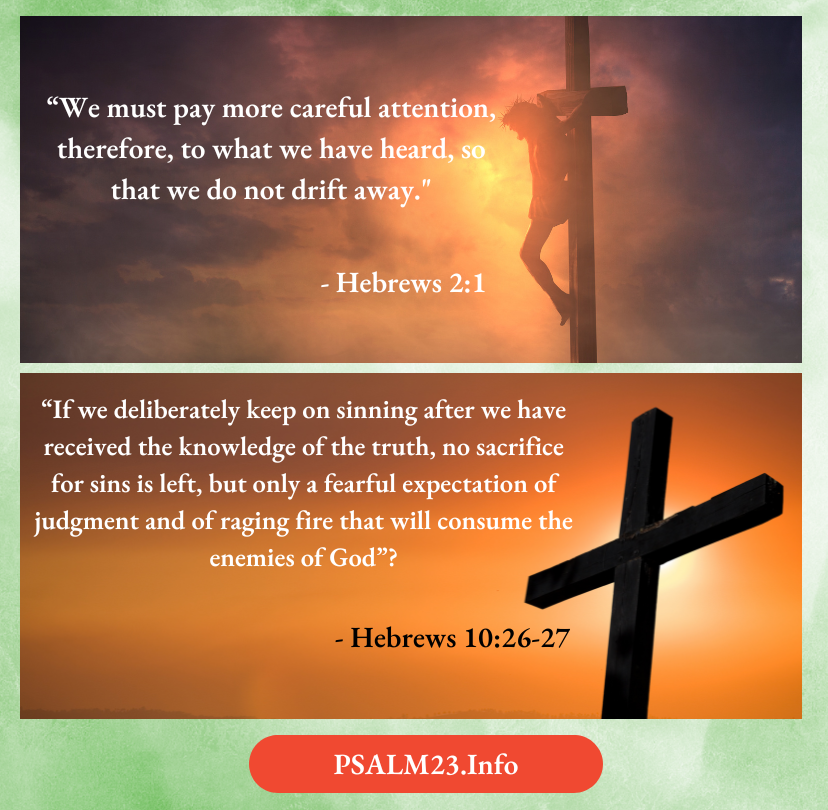
We must pay more careful attention, therefore, to what we have heard, so that we do not drift away

We must interpret these passages in light of the fact that it is quite possible to make a false profession of faith. Not all who claim to follow Christ have undergone a genuine transformation.

If a person deliberately goes on sinning or if someone falls away from the faith, this is not sufficient to show that this person has lost his salvation. Rather, in light of the assurance of salvation that Scripture gives to those who are truly saved, we must conclude that such a person has never been genuinely saved at any time.

What about the specific cases of apostasy mentioned in Scripture, particularly those Paul notes in 2 Timothy? For example, Hymenaeus and Philetus are said to “have wandered away from the truth” (2 Timothy 2:17-18).

2 Timothy 2-17-28

Later on in the same letter (4:10), Paul writes, “Demas, because he loved this world, has deserted me and has gone to Thessalonica.” Once again, unless it can be proved that the conversion of the aforementioned individuals to the faith was genuine (which it cannot be), we must let the overwhelming testimony of Scripture speak for itself.

Those whom God has elected from before the foundation of the world and for whom Christ has shed His blood, those whom God has regenerated and called through His Holy Spirit, those whom He has justified, He will most certainly glorify. He will preserve the saints for all eternity.




What Does The Bible Say About Conflict Resolution?

Dealing With Conflict

No matter how patient and understanding you become, you will experience conflict with others from time to time. God’s word teaches us that it is always best to deal with conflict through understanding and love:

But the wisdom from above is first of all pure. It is also peace-loving, gentle at all times, and willing to yield to others. It is full of mercy and good deeds. It shows no favoritism and is always sincere.

Experts agree there are five methods for dealing with conflict as it arises:

1. Attack! Attacking is the least effective method and the most contrary to how God wants us to behave in this world. When we attack, we lash out aggressively at the conflict and the person.

Read and Learn More How Leaders Can Cultivate Patience in an Impatient World ?

Because emotions and adrenaline are high, it is very tempting to use this method when dealing with conflict. But keep in mind that the source of the conflict is Satan, who loves to stir up trouble.

When negative, hurtful emotions are present in a situation, Satan slithers in and makes it even worse. The good news is, that Satan doesn’t have any ammunition against gentleness, compassion, understanding, or love.

If we can learn to deal with conflict using these tools, his meddling will be obstructed, and God’s love can get to work.

Proverbs 15.1

2. Avoid. When you avoid conflict, you are running away from it. Your hope is not to resolve it, but for it to just go away altogether. While this approach is preferable to attacking, it doesn’t get to the root of the conflict.

Often, you don’t avoid it at all – you just move the conflict inside of you. You feel hurt and wronged, spend lots of time and negative emotions thinking about the conflict, and may even subconsciously look for ways to get even with the other person.

The final three methods for dealing with conflict are much more productive and preferable in God’s eyes. Also, they will bring you more peace of mind. Each has its useful place, depending on your relationship with the person.

3. Walk Away. While this method may appear similar to “avoid,” it is entirely different. When you walk away from a conflict, you are consciously deciding that it does not affect your goals, and it is not important enough to give attention. So you just let it go and forget about it.

When you develop the ability to walk away from a petty or inconsequential conflict, you develop a positive reputation for being even-minded and understanding. You are better able to manage your time and emotions and stay focused on your purpose in life.

4. Prevent. You may be able to anticipate the potential conflict and take action to prevent it before it even occurs. This strategy is different than “avoid” or “walk away” because you are proactive.

It is a preemptive resolution! When you prevent a potential conflict, you are better able to develop high-quality solutions and demonstrate excellent leadership qualities. Here are a few ideas to prevent conflict:

Don’t allow a minor argument to turn into a big one. To do this, you have to be able to step back, analyze your emotions, and make the commitment to find a solution to what is bothering you and the other person.

James 3-17-18

Analyze expectations in advance. Conflicts often develop when someone has unmet expectations. If communication with someone is getting rough, take a step back and try to determine what the other person expected that didn’t happen.

Recognize that the other person is looking at the world with different perceptions than you are. Everyone sees things a little differently based on their background, personality, and culture, and if this isn’t understood, then you may not be able to prevent conflict.

Recognize that mistakes happen. Sometimes, people just make unintended errors. Before blowing up, do a reality check and ask yourself if what is bothering you could be the result of a mistake.

If you made a mistake, apologize and work toward correcting it. If it is the error of the other party, identify it objectively and work toward correcting the mistake and preventing a conflict.

5. Resolve. Finally, if you can’t walk away from or prevent the conflict, you must take action to investigate the source, use problem-solving skills, and try to find a solution that works.

By taking the initiative to resolve conflicts when they arise, you reduce stress, create positive rather than negative energy, and improve your relationships. Here are a few ideas to assist in resolving conflict:

Commit to working it out. A positive impact will instantly result when you promise to find a resolution. It can turn a negative situation positive one immediately.

Ask Questions. Most of the time, the conflict occurred because of poor communication. As part of your goal to resolve the dispute, ask lots of questions, which will help to get to the root of the conflict and resolve it much more quickly.

Eliminate the E’s. Do not allow exaggerations, embellishments, or egos to get in the way of working toward a resolution.

How Can You Develop Patience According To The Bible?

Strategies For Developing More Patience With People

We are encouraged to deal with people with patience and understanding because it puts our witness on display in a very tangible way. That can be hard! So it is a good idea to fill your toolbox with techniques for releasing the negative thoughts that you experience about other people.

Doing so will open room in your heart and mind for God’s comfort and support that is so desperately needed to demonstrate patience. Here are a few ideas to help release that negative energy and build your tolerance towards others.

Hebrews 12-14 and Romans 12-18

Releasing

Here is a simple exercise you can use to help release the negative energy that happens when you get annoyed or impatient, providing room for more positive, empowering thoughts.

Read and Learn More How Leaders Can Cultivate Patience in an Impatient World ?

Awareness. First, become aware of your feelings. What sensations and emotions are going on inside you? Are you uncomfortable, doubtful, upset, peeved, frustrated, or angry? Try to give voice to the actual feelings you are encountering.

Acceptance. Let the unwanted feeling rise to the surface of your awareness. Feel it completely – don’t push it back into your subconscious.

Be aware of the feeling and accept it. Tell yourself, just as if you were counseling a friend, that it’s okay to have that feeling.

Let Go. Finally, let go! Let go of the unwanted feelings and energy. Let them flow out of your body. Visualize the negative feelings leaving you by creating an image of that release.

For example, you may want to picture a teakettle letting off steam, or a water dam breaking and the water gushing over the edge.

I like to imagine a funny cartoon character exploding like in a Roadrunner cartoon. Use whatever will work for you to release completely the negative feelings you have.

Go through this exercise as many times as you need to fully release the negative emotions. You will probably find that each time you go through it, the negative feelings will lessen a little bit more.

If you practice the exercise whenever you feel tense and impatient, it will become easier to let go of the negative feelings quickly.

Eventually, you won’t even have to go through the steps consciously, and will instead jump right to your release visual.

Softening

Imagine you have a customer that just does not have it together. He is slow getting you the details you need to finish a task for him and the information he sends you is incomplete.

You end up spending a lot of your time looking for his errors and correcting his work. That takes you away from tasks for other customers that you had planned.

When you are talking to yourself and others, what words would you use to describe this client? If your descriptions are full of negatively charged words, you will create much stronger emotions than if you can soften the emotional impact of the words you choose.

At the same time, this is most definitely right about what we say to others.

Proverbs 15-1

We often forget that the words we speak to ourselves have a tremendous impact as well. Choosing kinder, gentler words throughout your day can help you develop the patience you need to deal with difficult people.

For example, read the following sentences and let yourself feel the emotions that arise when using the different words:

  1. It infuriates me that I have to redo his work every time.
  2. I get annoyed when I have to redo his work every time.
  3. She is so rigid it makes me angry!
  4. Her determination can be irritable at times.
  5. That moron got these figures wrong again.
  6. He sure can be distracted – he got these figures wrong again.

Do you notice how the first sentence stirs up negative emotions within you while the second softens them? People will be annoying – it is a fact of life.

But by using less emotionally charged words to describe your negative reactions to people, you are looking at the world through God’s eyes, not Satan’s, which will develop peace of mind and harmony.

That is a state that is much more helpful in building patience with people. Another trick I suggest when using this technique is to find a “softened” word that you think is amusing.

For example, when I feel myself becoming angry or upset, I use the word “peeved.” It’s such a silly word that I find myself smiling a little, and the negatively charged emotions that were stewing up inside me instantly calm.

Try to come up with words like that to soften emotions that you often feel. Here are a few possible suggestions for softened words:

I feel humiliated— I feel perturbed

I feel controlled — I feel hassled

I feel manipulated — I feel hoodwinked

I feel ignored — I feel tuned out

I feel punished – – – I feel scolded

You can come up with your set of replacement words that soften those negatively charged words that you find yourself using over and over again.

Become an Inverse Paranoid

One last technique is to practice what Jack Canfield likes to call “inverse paranoia.” For developing patience with other people, inverse paranoia means that instead of thinking that an annoying person is plotting to do you harm.

You should instead believe that they are planning to do you good. Or, at the very least, be aware that everyone is dealing with struggles, weaknesses, setbacks, and obstacles. It is not all about you.

Practicing inverse paranoia shifts the focus from “what’s in it for me” to a collaborative mentality that can benefit everyone involved. Imagine how much easier.

It would be if everyone went through life expecting other people to support them and build them up, rather than worried about how to save their skins.

1 Thessalonians 5-11

And the good news is that when you start practicing inverse paranoia, people around you will change and practice it as well.

That is why Paul inspires the Thessalonians. What goes around, comes around!

Perfect Patience with the Worst of Sinners

The Ultimate Example Of Patience With Other People

The greatest example of patience that we could emulate is Jesus Christ. Surely Christ had a lot of circumstances in His life requiring patience, such as enduring the shame, ridicule, and torture He did to die on the cross.

While Jesus’ patience towards His disciples is less obvious, it’s no less important as we learn to be patient with other people.

The truth is, although Jesus could have picked anyone to be His disciples, the men he chose were very ‘human’ indeed. Some of them were simple fishermen. Matthew was a tax collector who cheated and hung out with sinners.

Read and Learn More How Leaders Can Cultivate Patience in an Impatient World ?

Simon the Zealot was what we would call a religious fanatic today. None of the men were great theologians or scholars. They often made mistakes and had doubts and lapses in faith all the time. In a nutshell, Jesus’s disciples were ordinary people, just like you and me!

2 Peter 3-15

And yet, Jesus patiently trained these regular guys over the course of His ministry to become mature men of faith. It wasn’t easy as these rookies were often confused as to who Jesus was and habitually misunderstood His mission. Here are a few great examples of the patience Jesus demonstrated.

James, John, and Mom

As Jesus was speaking about the things that were to come, Zebedee’s wife, whose sons were among Jesus’ disciples, came to Jesus with her sons and knelt down before Him to ask a favor.

Jesus: What do you want?

Zebedee’s Wife: When the kingdom of God is made manifest, I want one of my boys to sit at Your right hand, and one to sit at Your left hand.

Jesus (to all three): You don’t understand what you are asking. Can you drink the cup I am going to drink? Can you be ritually washed in baptism just as I have been baptized?

Zebedee Brothers: Of course!

Jesus: Yes, you will drink from My cup, and yes, you will be baptized as I have been. But the thrones to My right and My left are not Mine to grant. My Father has already given those seats to those for whom they were created.

The other ten disciples learned what the Zebedee brothers had asked of Jesus, and they were upset. So Jesus called the disciples together.

Jesus: Do you want the Kingdom to run like the Romans run their kingdom? Their rulers have great power over the people, but God the Father doesn’t play by the Romans’ rules.

This is the Kingdom’s logic: whoever wants to become great must first make himself a servant; whoever wants to be first must bind himself as a slave.

Matthew 20-20-28

Are you a high achiever? If you are, this story is for you and can teach a real lesson about the difference between tolerant leadership versus plain old ambition.

Here we have the stuff of soap operas. Two of Jesus’ disciples and their mother attempt a power play for preferential treatment in the Kingdom of God.

James and John were cousins of Jesus, so that may be why they thought they had the right to make such a request. But the other disciples didn’t see it that way and were not happy about it!

The problem, of course, was that the disciples still didn’t understand that God’s Kingdom was not a worldly place. Even after all the time and patience Jesus had taken to teach them about the Kingdom of God and His coming death, they still didn’t get it.

They were thinking of a worldly kingdom – gold thrones, servants, and their place next to the indestructible king, Jesus. Difficult to believe? Maybe.

My husband was a Little League baseball coach for several years. He just loved finding the ball player’s hidden talents and passions. The people that were hard for him to work with, however, were the parents.

He would spend hours figuring out the right field positions and batting orders for the game, only to have to deal with an eager parent who wanted to see their boy play a particular position or more innings.

These pushy parents weren’t bad people; they were just looking out for the player that was most important to them. Unfortunately, they didn’t see the big picture and didn’t understand that their ambitions for their sons didn’t fit into the overall plan for the game. A little bit like the disciples, hm?

Now I think it is safe to say that James and John were not evil, power-hungry men. After all, they were hand-chosen to be Jesus’ disciples.

But they were human, and in being human, they made human mistakes: First in misunderstanding what God’s kingdom was, and second by seeing themselves in the center of the more worldly kingdom they were picturing – full of power, riches, and influence.

Knowing that not only was Jesus fully God, but also fully human, I wonder what Jesus’ human reaction to James, John, and even the other disciples’ righteous objections would have been.

We may never know, except to compare it to how we might react in the same situation. But instead of lashing out in impatience as we might, Jesus demonstrated perfect patience.

Notice he didn’t reproach James or John for their high-reaching request, or the other disciples for their less-than-loving response; instead, he turned the situation into another opportunity to teach the disciples about the real kingdom of God.

Thomas and Philip’s Confusion

Thomas: Lord, we don’t know where You are going, so how can we know the path?

Jesus: I am the path, the truth, and the energy of life. No one comes to the Father except through Me. If you know me, you know the Father. Rest assured now; you know Him and have seen Him.

Philip: Lord, all I am asking is that You show us the Father.

Jesus (to Philip): I have lived with you all this time, and you still don’t know who I am. If you have seen Me, you have seen the Father. How can you keep asking to see the Father? Don’t you believe Me when I say I abide in the Father, and the Father dwells in Me?

I’m not making this up as I go along. The Father has given me these truths that I have been speaking to you, and He empowers all My actions. Accept these truths: I am in the Father, and the Father is in Me. If you have trouble believing based on My words, believe because of the things I have done.

John 14-5-11

For over two years, day by day, Jesus had been showing his apostles that he was the spitting image of God the Father. In fact, he was God the Father; His words and actions, his thoughts, his emotions, his purpose, and his spirit all revealed that of His Father in Heaven.

And yet Philip says, “Lord, show us the Father, and that will be enough for us,” like he hasn’t been looking at him in the face for two years. Jesus answers Philip, “Anyone who has seen me has seen the Father. If you can’t believe what I say, at least believe what I’ve done.”

In other words, “It may seem bold of me to say so, but how else do you explain how I was able to cure the sick, feed five thousand, and even raise Lazarus from the dead?” I have a small human glimpse of how Jesus must have felt.

Exhibit number one: my husband who, despite the fact that I never wear his shoes or drive his car, seems to think I know exactly where all of his belongings are at any given moment. If something is missing, he calls out “Where is my __?” and then stands there waiting for me to find it.

Nine times out of ten the “missing” item is staring him right in the face if he’d just bother to take a look. He may not be asking me where God the Father is, but, like Thomas and Philip, he is blind to something that is right in front of his eyes.

Judging by how quickly I lose my temper with him, it’s unbelievable to me that Jesus could be so patient and understanding with their ignorance over a much more important matter.

In the Garden

It is indeed a dark, bitter night. The disciples are sad and confused, and maybe a little bit prideful. Peter cannot believe that he could ever betray his Lord.

At that, Jesus led His disciples to the place called Gethsemane.

Jesus: I am going over there to pray. You sit here while I’m in prayer.

Then He took Peter and the two sons of Zebedee with Him, and He grew sorrowful and deeply distressed.

Jesus: My soul is overwhelmed with grief, to the point of death. Stay here and keep watch with Me. He walked a little farther and finally fell prostrate and prayed.

Jesus: Father, this is the last thing I want. If there is any way, please take this bitter cup from Me. Not My will, but Yours be done.

When He came back to the disciples, He saw that they were asleep. Peter awoke a little less confident and slightly chagrined.

Jesus (to Peter): So you couldn’t keep watch with Me for just one short hour? Now maybe you’re learning: the spirit is willing, but the body is weak.

Watch and pray and take care that you are not pulled down during a time of testing.

With that, Jesus returned to His secluded spot to pray again.

Jesus: Father, if there is no other way for this cup to pass without My drinking it then not My will, but Yours be done.

Matthew 26-36-46

Again Jesus returned to His disciples and found them asleep. Their eyes were heavy-lidded. So Jesus left them again and returned to prayer, praying the same sentiments with the same words. Again He returned to His disciples.

Jesus: Well, you are still sleeping; are you getting a good long rest?

This story doesn’t need much explanation of Jesus’ extreme patience with his disciples, particularly for those of us who have trouble staying up late at night.

I can’t count the number of times I have fallen asleep watching a movie only to be awoken by flying objects like pillows and wadded-up paper thrown by my annoyed husband and kids!

Jesus had asked His disciples to stay awake to support Him not only in prayer but by just being there during what would be His most challenging trial. That’s a little bit more important than watching a movie.

But, did Jesus lose it and throw things or yell at the disciples? No, He understood with quiet patience. And, because Jesus was at peace, He was able to accept what His disciples did offer Him, limited as it was.

These stories remind us that we need to thank Jesus for His patience with us for our lack of knowledge and understanding of Him, just like He was patient with His disciples. But we should also use His examples to practice the fruit of patience in our lives.

What Does The Bible Say About Patience?

Demonstrating Patience With Other People

Since God chose you to be the holy people he loves, you must clothe yourselves with tenderhearted mercy, kindness, humility, gentleness, and patience. Make allowance for each other’s faults, and forgive anyone who offends you. Remember, the Lord forgave you, so you must forgive others.

Demonstrating patience with other people can be one of the most powerful examples of God’s love for us. As the Golden Rule teaches, we are to do to others as we would like others to do to us.

I can’t think of any instance where I wouldn’t want other people to treat me with kindness, compassion, and especially patience. As God’s children, our patience affects our ability to be a positive example and to share God’s message with the world.

Knowing that, unfortunately, doesn’t make being patient with other people any easier! The truth is, some folks will try your patience regularly.

It’s tough to get along with someone who continually interrupts what you are saying, bothers you at work, has terrible timing, or tells boring story after boring story.

Read and Learn More How Leaders Can Cultivate Patience in an Impatient World ?

Colossians 3-12-13

Sometimes, our impatience with other people injures no one but ourselves, such as the silent, petty impatience with perfect strangers we experience throughout the day.

For example, how many times have you secretly fumed at a very slow customer you got stuck behind in the grocery store? Do you think he realized how annoyed he made you?

I am a very fast walker, so one area where I am challenged to keep my patience is when I get trapped behind a bunch of slower walkers. They may be having a great time meandering down the walk, catching up on a conversation.

But I am immune to their good times. I bounce on my toes like an Olympic sprinter, waiting and watching for any opening where I can squeeze in and pass the inconsiderate horde.

The fact of the matter is that your anger and impatience toward those loud people at the next table or the teenagers who rammed into you on the bus don’t affect them in the least.

They are oblivious and, while rude; they aren’t out to get you personally. Most of the time, we just endure it silently. But instead of letting it go, we can let these nuisances build until our whole attitude is damaged.

God teaches us to release the negative emotions that these petty annoyances can cause and to set our minds on more constructive endeavors:

And now, dear brothers and sisters, one final thing. Fix your thoughts on what is true, and honorable, and right, and pure, and lovely, and admirable.

Philippians 4-8

Most often, our impatience is directed not to the strangers on the street, but toward our friends, family, and co-workers, which can negatively affect our relationships and lead to unresolved conflict.

God wants us to treat others with the respect and empathy they deserve as children of God. As annoying as people may be, they are important and unique to God, made in His image. Every one of us has immeasurable value, just because He created us.

Demonstrating patience with other people helps develop understanding, empathy, and compassion. Part of being patient is to learn to work out our conflicts.

Patient people take the time to process what they go through and identify which things that bother them are valid and need attention, and which are petty and picky. This results in better, more fulfilling relationships with spouses, friends, children, and bosses.

Proverbs 14-29

Impatience with another person often occurs when we think that person is in some way hampering our goals. We may even believe they are challenging or condemning us; we don’t feel support for our desires, so we get annoyed and impatient.

The truth of the matter is that we all approach life from a different perspective, but for each and every person that perspective has ‘me’ in the center. All other individuals and circumstances ripple out from that center.

Our goal as Christians is to learn to take ‘me’ from the center of our perspective and replace it with ‘God.’ On the occasions we can pull that off, our first reaction to an irritating person is not to complain about them verbally or internally, but to deal with the situation with optimistic endurance.

Doing so creates more patience and compassion; we learn to overlook their shortcomings, knowing that we probably have a few of our own! The ability to replace ‘me’ with ‘God’ and to deal with annoying people with patience doesn’t happen overnight.

Like a bodybuilder must work out their muscles to grow stronger, we need to take the time to develop our patience toward other people. Chapters four and five will give you some tips and techniques to help you build that strength.

Developing Patience And Perseverance In An Impatient World

Developing Patience And Perseverance In An Impatient World Introduction

There was once a young man with big dreams. The boy knew his dreams came from God, but his family didn’t agree.

His parents humored him. “Sure, honey, you can do anything you want to in life.”

His brothers were not as understanding as his parents. They were quite angry that, according to the young man, they would bow down and grovel to the boy in the dreams he described.

It was bad enough that their little brother was the favorite in the family, arriving when Dad had already made it and was reconciling to the fact that he probably wouldn’t have any more kids. “The child of my old age,” Dad used to say.

He had turned 17 and was almost a man. But Dad let him dress up in fancy clothes and kept him back from doing the hard work in the fields. What a sissy. Then one day, they found their chance to get even.

So begins the saga of Joseph, spanning many chapters of Genesis. Joseph’s tale is one of the most revealing stories of how to demonstrate patience that the Bible tells.

Read and Learn More How Leaders Can Cultivate Patience in an Impatient World ?

Genesis 37

Amidst the drama of family jealousy, abuse, sex scandals, royal intrigue, and natural disasters, Joseph’s unwavering patience as he waited on God’s will is a lesson for us all.

A lesson we seem to need every day of our lives.

I often wonder if the Bible has so many lessons for how to develop and demonstrate patience because it is such an unnatural way to think in this world. It seems like as soon as we set a goal, various obstacles start to get in the way, keeping us from achieving this aim.

We, in turn, become impatient with other people, the situation, and even with ourselves.

Satan knows just where to strike once we’ve set a goal. And he uses our impatience as a prime way to keep us from focusing on and trusting God. What happens when we are impatient? The symptoms evidence themselves in different ways for everybody.

You may get upset and angry, quickly lose control, and have bursts of temper and blame. You may burn out quickly or become pessimistic. Perhaps you will discard relationships, jobs, or organizations when things don’t work out as you expected.

Or withdraw from a situation when you don’t see immediate results. You may just go through life with an underlying dissatisfaction, never happy or joyful. Ultimately, impatience will lead to depression and the feeling that you just can’t cope anymore.

Joseph certainly had the right to experience all these impatient feelings, and yet his story over the course of fifteen years tells another tale.

Joseph suffered ridicule and verbal abuse from his brothers. Those same brothers eventually beat him up, threw him into a deep hole in the ground, and sold him to passing merchants for a few bucks.

Joseph’s life got even more complicated. He became a servant in a prosperous home in Egypt, and dutifully performed his assignments until his master gave him a prominent position managing his household.

Before long, the lady of the house got the hots for him and did her best to seduce him. When Joseph said no, she stole his clothes and lied, accusing him of attempting to rape her.

Thrown into bondage again, Joseph endured the indignities of prison life and made friends the best he could with his fellow inmates.

Through this, Joseph kept the dreams that God placed in his heart alive and his eye on the goal. He probably still didn’t see how he would become a great leader, but Joseph knew God had those plans for him, and he was willing to wait it out.

One day, Joseph used his ability to interpret dreams to help out a couple of fellow inmates who had previously worked in Pharaoh’s palace.

If his analysis was correct, their dreams foretold that the baker would hang in three days, and the Butler would be cleared of blame and restored to his previous position. Here is the part of the story where Joseph shows humanity that we can relate to.

He begs the Butler to share his story and get Joseph out of jail already! Was Joseph FINALLY demonstrating some impatience of his own by trying to mold the situation to his liking? Or was he merely using the tools available to him to play an active role in God’s plan for him?

We struggle with the same question in our lives, and, like Joseph, we may never know the answer. Because once Joseph’s prediction came to pass and the Butler was restored, he forgot to remember Joseph, who wasted away in jail for another two years.

As you can read in the 41st Chapter of Genesis, Joseph’s story does have a good ending. The Butler eventually remembered Joseph, and Pharaoh freed him from prison after Joseph interpreted the Pharaoh’s dreams.

The Pharaoh placed him in charge of all of his land to manage a coming famine. Joseph saved Egypt from starvation, reconciled with his family and they all lived happily ever after in Egypt.

How did Joseph endure those fifteen years and still come out on top? Any one of the many trials he encountered over the years could have been enough to send him over the edge. But instead, Joseph remained patient with his life, the people around him, and with God.

What is patience? Just waiting for something to happen doesn’t accurately define patience. If I have a good book, I can sit and wait for as long as is needed. That doesn’t make me patient, however, because the wait isn’t uncomfortable or troubling at all.

Dictionary.com defines patience as the bearing of provocation, annoyance, misfortune, or pain; without complaint, loss of temper, or irritation. But the story of Joseph, together with many other lessons in the Bible.

Teaches us that patience is not merely tolerating trials as a matter of necessity. Patience is enduring through a tenacious determination of will; to resolutely overcome the negative things we encounter, according to God’s will.
Joseph didn’t passively ignore his situation or quietly accept his lot in life. He remembered at all times that the Lord was with him and that He had a plan for Joseph’s life.

Genesis 39-2-3

With that in mind, Joseph was able to endure the times of trouble, stress, need, and anger, and remain faithful to stay the course.

The Bible uses these other phrases also to describe a patient spirit: slow to anger, long-suffering, enduring, and persevering. The dynamic characteristics of each of these phrases suggest that merely waiting won’t improve our fortune faster.

We will still struggle with our children, look for more money at the end of our paycheck, and have to wait for that annoying family in front of us at the supermarket.

But what these do hint at is an optimistic persistence caused by a peaceful mental attitude that helps us to be relaxed rather than frenzied while we wait. We don’t ‘check out’ of life; we sincerely look for opportunities to pursue our goals.

With optimistic persistence, a delay becomes more tolerable, and a job becomes easier. We are productive and enjoy the process more when we are patient with our circumstances.

In Luke 18:1-8, we read:

Luke 18-1-8

Jesus told them a story showing that it was necessary for them to pray consistently and never quit. He said, “There was once a judge in some city who never gave God a thought and cared nothing for people. A widow in that city kept after him: ‘My rights are being violated. Protect me!’

He never gave her the time of day. But after this went on and on he said to himself, ‘I care nothing of what God thinks, even less what people think.

But because this widow won’t quit badgering me, I’d better do something and see what she gets otherwise, I’m going to end up beaten black-blue by her pounding.”

Then the Master said, “Do you hear what that judge, corrupt as he is, is saying? So what makes you think God won’t step in and work justice for his chosen people, who continue to cry out for help?

Won’t he stick up for them? I assure you, he will. He will not drag his feet. But how much of that kind of persistent faith will the Son of Man find on the earth when he returns?”

The above story suggests three different types of patience that we should all work toward developing in our lives: patience with other people, with our circumstances, and finally, with ourselves.