
Patience With Yourself
“Have patience with all things, but chiefly have patience with yourself.
Do not lose courage in considering your own imperfections but instantly set about remedying them- every day begin the task anew.” Francis de Sales
Ultimately, any impatience – with others or with your circumstances, can be even further exacerbated if you are impatient with yourself.
It’s easy to blame another person or your circumstances rather than admit that you are disappointed with your performance.
Read and Learn More Prayers of Perseverance
It’s hard to live up to the standards you impose on yourself when you’re not patient with yourself when you make mistakes. You waste valuable time beating yourself up.
Impatience with yourself can lead to frustration, anxiety, disappointment, lowered self-esteem, and all kinds of negative thoughts and feelings.
You may even experience physical effects on your body, such as tensing in your neck and shoulders, extreme fatigue, and incomplete breathing.
We’d all like to be perfect, but only God is perfect. We’d all like to avoid the discomfort of messing up, but that can’t happen, either. The truth is, we are all just a work-in-progress.
For God is working in you, giving you the desire and the power to do what pleases him. It is okay to acknowledge our weaknesses so that we can work to correct them.
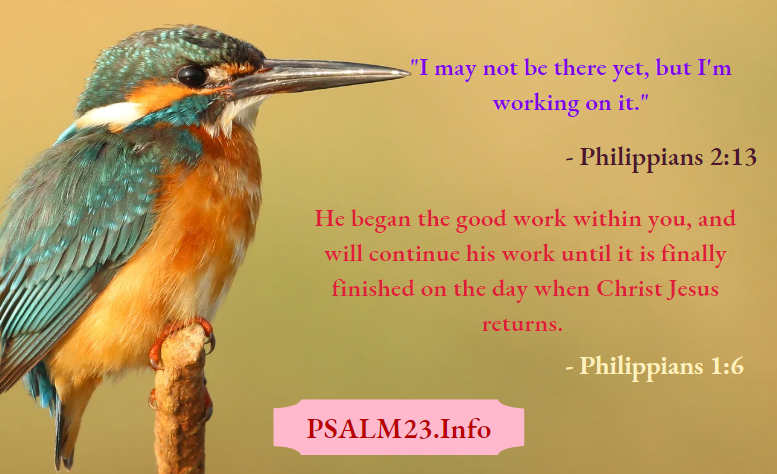
Don’t let your mistakes and challenges cause you to lose your enthusiasm for personal improvement and spiritual growth.
God has high expectations for us, but he also knows we are going to mess up. God is the God of second chances, and He will always be patient with us. We need to follow his example and learn to be patient with ourselves.
Remember that God is the one doing the work in us. Keeping that in mind will help to lighten the burden we feel to get better faster.
God will work with us on his own time, and all we can do is cooperate. We do that by building and improving on our talents and abilities so that we can become the best we can be.
Is there anything that can help you become more patient with yourself? All of the strategies and techniques presented thus far can help in this area as well.
Also, we all need to do our best to slowwww dowwwwwn. In our quest to get as much done in a day as humanly possible plus ten more things, it is very easy to get impatient with ourselves, especially if we can’t focus on the things that matter to us.
We get so busy doing what we have to do that there is little time for the things we want to do. And that makes us frustrated, unfulfilled, and yes, impatient with ourselves. Here are some ways to help us to slow down and focus on the things that matter to us:
Release stress and anxiety. Periodically throughout the day, take a quick assessment of your stress level. Do you have tense shoulders, arms, or legs? A headache? Having trouble concentrating on one thing? These are all signs of pent-up stress.
I find when I am most stressed my breathing becomes very shallow, making it difficult to get enough air, and making me feel exhausted.
When we have built up stress and anxiety, impatience is a frequent result. It starts with ourselves, and our inability to “get it all done.” Then it travels outwards to impatience toward other people and our circumstances.
It’s important to remember to release the mounting stress throughout the day rather than wait for the volcanic explosion that will come if it builds up.
Try to get some exercise each day and a healthy dose of motivation through God’s word and other inspiring speakers and authors.
If you feel stress starting to escalate, take several large, cleansing breaths and purposely slow your motions until you feel yourself calming.
Another thing that can help if you feel stress rising is to stop multitasking for a while.
We are fortunate to live in an age where we can achieve multiple things at the same time through instant messaging, email, and other convenient technology.
But long hours of piling one thing on top of another will take its toll. If you start to feel the stress of overload, pick just one task to work on for a half hour or until you feel yourself relaxing again.
Multi-task overload can even take over in the car; this is one of my weak spots. I drive many hours a day. On particularly busy days I have caught myself listening to the radio.
Trying to carry on a conversation, monitoring my text messages, taking notes on stray thoughts, and reading my Kindle at stoplights; not to mention trying to be a good driver.
I can almost see the stress expanding inside the car as I stack more and more on. It’s a wonder that when I finally open the doors, the vehicle doesn’t just combust.
I am slowly learning to shut it all down and just ‘drive’ instead of trying to conduct an entire day’s business in the car, which is helping to make me a more patient person all through the day.
Build your confidence in yourself and your abilities. Impatience with ourselves may happen when we feel that we don’t have control of a situation and that we have been let down (or have let someone else down).
We may even feel that our hands are tied. You want something to happen now, but you cannot seem to do anything to speed things up. When this type of thinking overtakes you, it’s time to sit back and remember something.
Remember, you aren’t in control, God is. You can’t do anything on your own to speed things up or make it right. God is on your side. God has chosen you, has created you, and you are a new creation in Him.
Blanket yourself in the knowledge that with God, all things will work out perfectly. Then go about your day with confidence and assurance in your God-given abilities.
Don’t fight or rail against it. Realize that patience and faith go hand in hand, and God is with you every step of the way.
Develop Perseverance. Active patience is critical when we are trying to be patient with ourselves. Nothing happens as quickly as we would like it to, and we must press on through the urge to quit.
I keep a magnet on my refrigerator that says P.U.S.H.: Pray Until Something Happens. I often think of that when I am discouraged by how long something is taking.
C.S. Lewis said “What saves a man is to take a step. Then another step.” And another, and another. After all, consider the alternative. What will happen if you do quit?
Paul is a great example to us of the attitude of perseverance. Throughout his ministry, he was persecuted, thrown in jail many times, and disdained by many.
He starved, he was cold, and he regularly traveled, enduring many hardships. He died a painful death when he was beheaded in Rome, not knowing if he ever actually reached his earthly goal.
But Paul’s attitude of perseverance lives on and is an example we can all follow. No, dear brothers and sisters, I have not achieved it, but I focus on this one thing: