
The Ultimate Example Of Patience With Other People
The greatest example of patience that we could emulate is Jesus Christ. Surely Christ had a lot of circumstances in His life requiring patience, such as enduring the shame, ridicule, and torture He did to die on the cross.
While Jesus’ patience towards His disciples is less obvious, it’s no less important as we learn to be patient with other people.
The truth is, although Jesus could have picked anyone to be His disciples, the men he chose were very ‘human’ indeed. Some of them were simple fishermen. Matthew was a tax collector who cheated and hung out with sinners.
Read and Learn More How Leaders Can Cultivate Patience in an Impatient World ?
Simon the Zealot was what we would call a religious fanatic today. None of the men were great theologians or scholars. They often made mistakes and had doubts and lapses in faith all the time. In a nutshell, Jesus’s disciples were ordinary people, just like you and me!

And yet, Jesus patiently trained these regular guys over the course of His ministry to become mature men of faith. It wasn’t easy as these rookies were often confused as to who Jesus was and habitually misunderstood His mission. Here are a few great examples of the patience Jesus demonstrated.
James, John, and Mom
As Jesus was speaking about the things that were to come, Zebedee’s wife, whose sons were among Jesus’ disciples, came to Jesus with her sons and knelt down before Him to ask a favor.
Jesus: What do you want?
Zebedee’s Wife: When the kingdom of God is made manifest, I want one of my boys to sit at Your right hand, and one to sit at Your left hand.
Jesus (to all three): You don’t understand what you are asking. Can you drink the cup I am going to drink? Can you be ritually washed in baptism just as I have been baptized?
Zebedee Brothers: Of course!
Jesus: Yes, you will drink from My cup, and yes, you will be baptized as I have been. But the thrones to My right and My left are not Mine to grant. My Father has already given those seats to those for whom they were created.
The other ten disciples learned what the Zebedee brothers had asked of Jesus, and they were upset. So Jesus called the disciples together.
Jesus: Do you want the Kingdom to run like the Romans run their kingdom? Their rulers have great power over the people, but God the Father doesn’t play by the Romans’ rules.
This is the Kingdom’s logic: whoever wants to become great must first make himself a servant; whoever wants to be first must bind himself as a slave.

Are you a high achiever? If you are, this story is for you and can teach a real lesson about the difference between tolerant leadership versus plain old ambition.
Here we have the stuff of soap operas. Two of Jesus’ disciples and their mother attempt a power play for preferential treatment in the Kingdom of God.
James and John were cousins of Jesus, so that may be why they thought they had the right to make such a request. But the other disciples didn’t see it that way and were not happy about it!
The problem, of course, was that the disciples still didn’t understand that God’s Kingdom was not a worldly place. Even after all the time and patience Jesus had taken to teach them about the Kingdom of God and His coming death, they still didn’t get it.
They were thinking of a worldly kingdom – gold thrones, servants, and their place next to the indestructible king, Jesus. Difficult to believe? Maybe.
My husband was a Little League baseball coach for several years. He just loved finding the ball player’s hidden talents and passions. The people that were hard for him to work with, however, were the parents.
He would spend hours figuring out the right field positions and batting orders for the game, only to have to deal with an eager parent who wanted to see their boy play a particular position or more innings.
These pushy parents weren’t bad people; they were just looking out for the player that was most important to them. Unfortunately, they didn’t see the big picture and didn’t understand that their ambitions for their sons didn’t fit into the overall plan for the game. A little bit like the disciples, hm?
Now I think it is safe to say that James and John were not evil, power-hungry men. After all, they were hand-chosen to be Jesus’ disciples.
But they were human, and in being human, they made human mistakes: First in misunderstanding what God’s kingdom was, and second by seeing themselves in the center of the more worldly kingdom they were picturing – full of power, riches, and influence.
Knowing that not only was Jesus fully God, but also fully human, I wonder what Jesus’ human reaction to James, John, and even the other disciples’ righteous objections would have been.
We may never know, except to compare it to how we might react in the same situation. But instead of lashing out in impatience as we might, Jesus demonstrated perfect patience.
Notice he didn’t reproach James or John for their high-reaching request, or the other disciples for their less-than-loving response; instead, he turned the situation into another opportunity to teach the disciples about the real kingdom of God.
Thomas and Philip’s Confusion
Thomas: Lord, we don’t know where You are going, so how can we know the path?
Jesus: I am the path, the truth, and the energy of life. No one comes to the Father except through Me. If you know me, you know the Father. Rest assured now; you know Him and have seen Him.
Philip: Lord, all I am asking is that You show us the Father.
Jesus (to Philip): I have lived with you all this time, and you still don’t know who I am. If you have seen Me, you have seen the Father. How can you keep asking to see the Father? Don’t you believe Me when I say I abide in the Father, and the Father dwells in Me?
I’m not making this up as I go along. The Father has given me these truths that I have been speaking to you, and He empowers all My actions. Accept these truths: I am in the Father, and the Father is in Me. If you have trouble believing based on My words, believe because of the things I have done.

For over two years, day by day, Jesus had been showing his apostles that he was the spitting image of God the Father. In fact, he was God the Father; His words and actions, his thoughts, his emotions, his purpose, and his spirit all revealed that of His Father in Heaven.
And yet Philip says, “Lord, show us the Father, and that will be enough for us,” like he hasn’t been looking at him in the face for two years. Jesus answers Philip, “Anyone who has seen me has seen the Father. If you can’t believe what I say, at least believe what I’ve done.”
In other words, “It may seem bold of me to say so, but how else do you explain how I was able to cure the sick, feed five thousand, and even raise Lazarus from the dead?” I have a small human glimpse of how Jesus must have felt.
Exhibit number one: my husband who, despite the fact that I never wear his shoes or drive his car, seems to think I know exactly where all of his belongings are at any given moment. If something is missing, he calls out “Where is my __?” and then stands there waiting for me to find it.
Nine times out of ten the “missing” item is staring him right in the face if he’d just bother to take a look. He may not be asking me where God the Father is, but, like Thomas and Philip, he is blind to something that is right in front of his eyes.
Judging by how quickly I lose my temper with him, it’s unbelievable to me that Jesus could be so patient and understanding with their ignorance over a much more important matter.
In the Garden
It is indeed a dark, bitter night. The disciples are sad and confused, and maybe a little bit prideful. Peter cannot believe that he could ever betray his Lord.
At that, Jesus led His disciples to the place called Gethsemane.
Jesus: I am going over there to pray. You sit here while I’m in prayer.
Then He took Peter and the two sons of Zebedee with Him, and He grew sorrowful and deeply distressed.
Jesus: My soul is overwhelmed with grief, to the point of death. Stay here and keep watch with Me. He walked a little farther and finally fell prostrate and prayed.
Jesus: Father, this is the last thing I want. If there is any way, please take this bitter cup from Me. Not My will, but Yours be done.
When He came back to the disciples, He saw that they were asleep. Peter awoke a little less confident and slightly chagrined.
Jesus (to Peter): So you couldn’t keep watch with Me for just one short hour? Now maybe you’re learning: the spirit is willing, but the body is weak.
Watch and pray and take care that you are not pulled down during a time of testing.
With that, Jesus returned to His secluded spot to pray again.
Jesus: Father, if there is no other way for this cup to pass without My drinking it then not My will, but Yours be done.
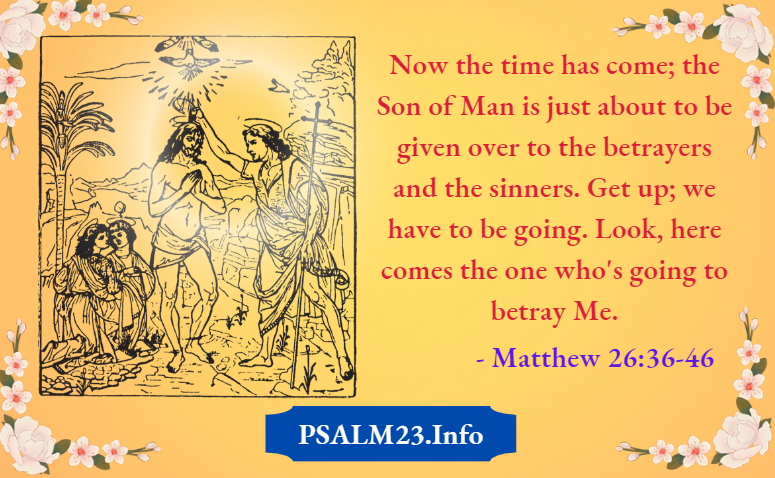
Again Jesus returned to His disciples and found them asleep. Their eyes were heavy-lidded. So Jesus left them again and returned to prayer, praying the same sentiments with the same words. Again He returned to His disciples.
Jesus: Well, you are still sleeping; are you getting a good long rest?
This story doesn’t need much explanation of Jesus’ extreme patience with his disciples, particularly for those of us who have trouble staying up late at night.
I can’t count the number of times I have fallen asleep watching a movie only to be awoken by flying objects like pillows and wadded-up paper thrown by my annoyed husband and kids!
Jesus had asked His disciples to stay awake to support Him not only in prayer but by just being there during what would be His most challenging trial. That’s a little bit more important than watching a movie.
But, did Jesus lose it and throw things or yell at the disciples? No, He understood with quiet patience. And, because Jesus was at peace, He was able to accept what His disciples did offer Him, limited as it was.
These stories remind us that we need to thank Jesus for His patience with us for our lack of knowledge and understanding of Him, just like He was patient with His disciples. But we should also use His examples to practice the fruit of patience in our lives.